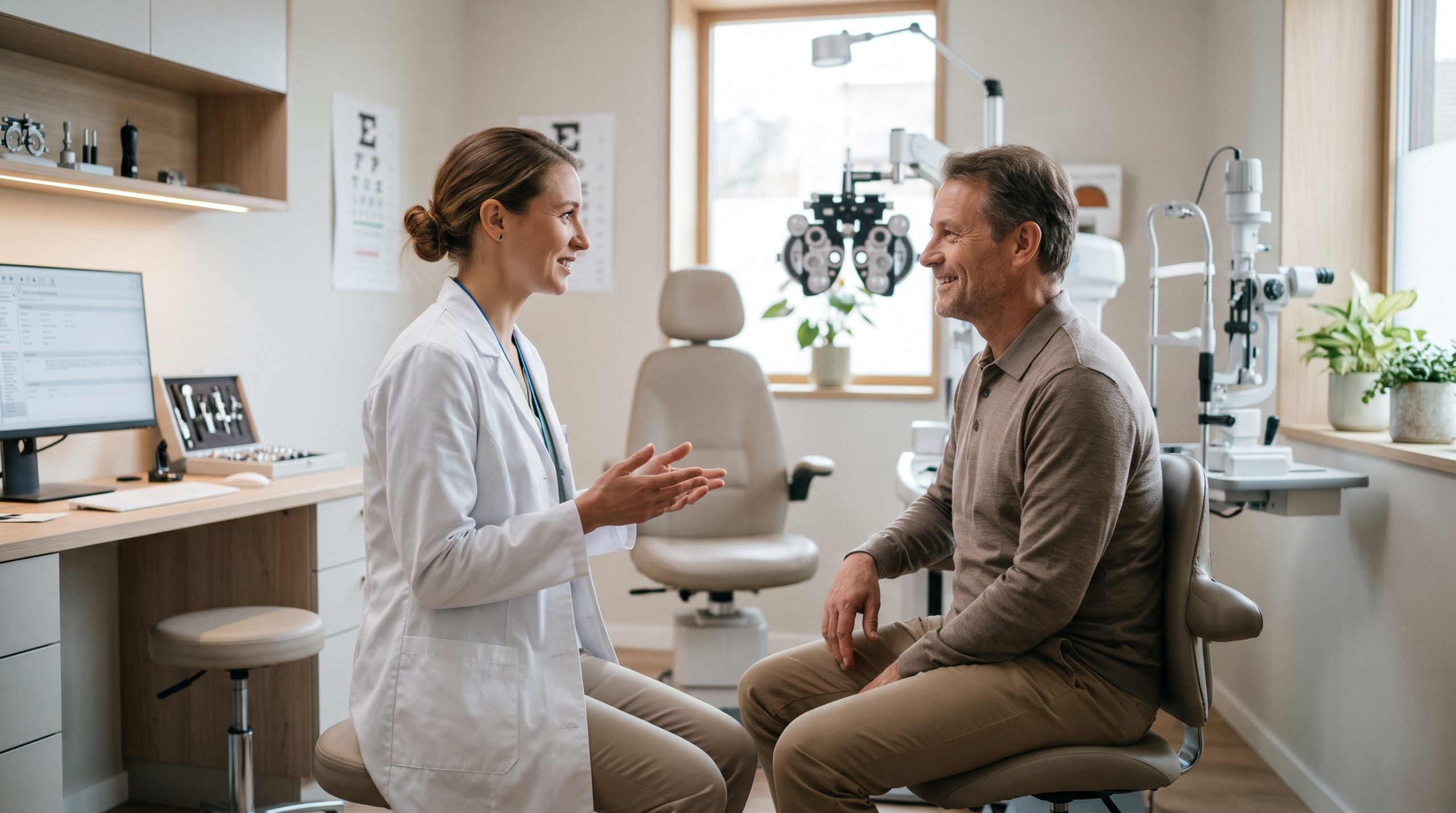
Aging eyes in Mechanicsburg, PA follow a predictable pattern that most adults encounter across similar decades of life. Some changes are entirely normal, including the gradual loss of near focusing ability that begins in the 40s and the reduced low-light adaptation that develops over time. Others are disease processes whose risk increases progressively with age, including cataracts, glaucoma, and age-related macular degeneration, and whose outcomes depend heavily on how early they are detected. Understanding what changes are coming, which decade typically brings each one, and how the right care responds to each stage helps Central Pennsylvania residents stay ahead of their eye health rather than reacting to problems after they have already developed.
Your 20s and 30s: The Most Stable Decade for Vision
For most adults, the 20s and early 30s represent the most stable period of vision in a lifetime. Refractive errors including myopia, hyperopia, and astigmatism that developed during childhood and adolescence tend to stabilize in the early 20s, and most young adults in this age range experience little change in their prescription from year to year.
According to West Boca Eye Center’s decade-by-decade prescription guide, eyesight in the 30s tends to be the sweet spot for prescription stability, though any visual changes should still be mentioned to your eye doctor who can adjust your prescription as needed. Even in this stable period, annual comprehensive eye exams serve a purpose: they establish baseline measurements of intraocular pressure, optic nerve appearance, and retinal health against which future changes are compared, and they identify any early findings that warrant monitoring before symptoms appear.
Digital eye strain is among the most common eye concerns for adults in this age range, given the screen time demands of modern professional life. Dry eye associated with reduced blink rate during concentrated screen use affects many young adults and is worth discussing during routine exams even when no other concerns are present.
Contact lens wearers in this age range should maintain annual exams for corneal health monitoring regardless of prescription stability. The AAO recommends annual eye exams for all contact lens wearers of any age.
Hampden Optical provides comprehensive eye exams for adults across all age groups in Mechanicsburg and surrounding Central Pennsylvania communities. Dr. David Paden OD, who completed a residency in referral-based optometry with an emphasis in ocular disease and refractive eye care, leads the clinical team alongside owners Noelle and Michele, both board certified opticians with more than 25 years of experience each.
Your 40s: The Decade Presbyopia Arrives
The most universal age-related vision change, and the one that surprises more adults than any other, is presbyopia. It arrives predictably in the early to mid-40s for virtually everyone and represents the normal hardening of the eye’s crystalline lens that reduces its ability to flex and change shape for near focus.
According to the American Academy of Ophthalmology, presbyopia is common after the age of 40. The experience is consistent across individuals: fine print that was previously comfortable to read now requires more distance, restaurant menus need to be held at arm’s length, and reading in low light becomes notably more difficult. The lens, which was flexible enough in youth to accommodate instantly between distance and near focus, gradually loses that flexibility as the lens proteins change with age.
Presbyopia does not mean vision is deteriorating. It means the accommodative mechanism that handled near focus has reached its natural limit. The correction options are multiple and well-established: reading glasses for those who do not wear distance correction, bifocal or progressive lenses for those who do, and multifocal contact lens options for those who prefer not to wear glasses. According to the AAO, there are now also prescription eye drop medications taken daily that help improve reduced near vision from presbyopia for patients who prefer a pharmaceutical approach.
Beyond presbyopia, the 40s are when optometrists begin monitoring specifically for the early signs of the age-related diseases whose risk starts climbing in this decade. The AAO recommends that all adults receive a baseline comprehensive eye exam at age 40, even without symptoms, specifically because this is when early signs of glaucoma, cataracts, and macular degeneration can begin to appear. Dry eye also becomes more common in the 40s, particularly for women whose hormonal changes affect tear film composition.
Your 50s: Rising Risk for Age-Related Conditions
The 50s are when the risk profile for eye disease changes meaningfully and when the monitoring component of the annual exam becomes clinically more significant alongside the vision correction component.
Presbyopia continues to progress through the 50s, often requiring prescription updates more frequently than in the 40s as the near correction needs to increase to keep pace with continuing lens hardening. According to All About Vision’s age-related vision change guide, multiple eyewear solutions might be needed for presbyopia at this age, with some patients using different pairs for different tasks or different distances.
Cataract development accelerates in the 50s for many adults, though most cataracts at this stage are early-stage clouding that affects vision subtly rather than dramatically. The first signs are often increased sensitivity to glare, particularly from oncoming headlights at night, and a gradual overall reduction in contrast and color vibrancy. According to Cleveland Clinic’s age-related eye problems resource, proteins in the lens start to break down as you get older, which can lead to cataracts. The rate of progression varies significantly between individuals, and the timing of surgical intervention is determined by how much the cataract is affecting daily function rather than its appearance on examination.
Glaucoma risk increases substantially after 50. The AAO identifies age as one of the strongest risk factors for primary open-angle glaucoma, the most common form, and notes that people of all ages can be diagnosed but the disease is most common among older adults. Because glaucoma causes gradual peripheral vision loss without early symptoms, the annual intraocular pressure measurement and optic nerve evaluation that are part of a comprehensive exam are the primary means of early detection. According to Frame and Focus Eye Care’s aging eye guide, a 2022 study found that approximately 4.22 million US adults have glaucoma, and about half are unaware, making regular monitoring essential.
Age-related macular degeneration begins to appear more commonly in the 50s, particularly in adults with a family history of AMD, significant UV exposure history, or smoking history. Early AMD involves the development of drusen deposits beneath the macula and does not typically cause noticeable vision change in its early stages. The retinal examination during a dilated comprehensive exam identifies these early changes and determines the appropriate monitoring schedule and any lifestyle or supplemental interventions that may slow progression.
Dry eye worsens for many adults in the 50s, particularly for postmenopausal women whose hormonal changes affect the meibomian glands that produce the lipid layer of the tear film. According to Schmidt Family Eye Care’s age-related eye condition guide, the risk of developing dry eyes increases especially for postmenopausal women in the 50s. Management options for dry eye have expanded considerably in recent years and are most effective when the underlying cause is properly identified rather than managed with artificial tears alone.
Your 60s: When Age-Related Diseases Become Primary Focus
The 60s are when cataracts, glaucoma, and AMD transition for many adults from conditions being monitored to conditions being managed. The exam schedule and clinical priorities shift accordingly.
Cataracts become more prevalent and more visually significant through this decade. According to All About Vision, the 60s are the most common decade for cataracts to be diagnosed at a level that affects daily function. When a cataract has progressed to the point where it is reducing the vision necessary for driving, reading, or other daily activities, surgical intervention is typically recommended. Cataract surgery is one of the most common and most successful surgical procedures performed in the United States, with high rates of vision restoration and low complication rates when performed by experienced surgeons.
Color perception changes subtly with the development of cataracts and the changes in lens clarity that occur even without diagnosed cataracts. Colors can appear less vivid, and the warm yellow tones that the aging lens imparts can affect how certain colors are distinguished. This is a normal change that many adults in their 60s notice gradually.
Night vision becomes less reliable for most adults in their 60s through a combination of factors including pupil size reduction with age, reduced rod cell sensitivity, and any early lens clarity changes. The rod cells responsible for low-light vision weaken with age according to AAO’s aging eye research, and the reduced pupil size that comes with aging limits the amount of light entering the eye in dark conditions. Adjustments including allowing more time for dark adaptation, using better lighting for near tasks, and being cautious about night driving in poor conditions are practical responses to these normal changes.
AMD management becomes more active if intermediate or advanced AMD has been identified. Treatment with anti-VEGF injections for wet AMD has significantly improved outcomes for patients whose AMD progresses to the neovascular form. For dry AMD, the AREDS2 nutritional supplement formulation including lutein, zeaxanthin, vitamin C, vitamin E, and zinc has been shown to reduce the risk of progression to advanced AMD in patients with intermediate dry AMD.
Your 70s and Beyond: Managing Vision in Later Life
Adults in their 70s and beyond are managing a combination of the changes that began in earlier decades alongside the higher prevalence of serious age-related conditions that affects this age group.
According to the AAO, half of Americans over the age of 75 develop cataracts, a figure that underscores how universal this condition becomes in later life. For those who have not yet had cataract surgery, the decision about timing is made based on functional impact rather than a specific level of lens clouding. For those who have had cataract surgery, the implanted intraocular lens typically provides stable vision without further changes from cataract development.
Peripheral vision narrows gradually with age as a normal physiological change. According to Frame and Focus Eye Care’s aging eye research, researchers suggest that peripheral vision decreases at a rate of approximately one to three percent per decade of life. This narrowing has practical implications for driving and spatial awareness that are worth discussing with an optometrist as part of the annual exam in this age group.
Falls are one of the most significant health risks for older adults, and vision changes including reduced contrast sensitivity, narrowed peripheral vision, and difficulty with depth perception contribute to fall risk. Ensuring that the current prescription is accurate and that any treatable vision changes are addressed is a direct contribution to fall prevention in this age group.
AMD monitoring continues as a priority given that this age group has the highest prevalence of advanced AMD. The NEI’s research indicates that age-related macular degeneration affects approximately 19.83 million Americans, with adults over 50 at significantly elevated risk and the oldest adults at the highest risk. Home monitoring with an Amsler grid between professional exams helps patients detect the distortion or central vision changes that signal progression to wet AMD and prompt timely treatment.
How the Exam Schedule Adapts to Each Life Stage
The exam schedule and what the exam focuses on both change as the decade changes. Understanding this progression helps adults across Mechanicsburg and Central Pennsylvania know what to expect at each stage.
In the 20s and 30s, the exam confirms prescription stability, monitors contact lens wear if applicable, and establishes baseline measurements. In the 40s, the exam adds a specific evaluation of near vision correction needs and begins monitoring specifically for early signs of the conditions that increase in prevalence after 50. In the 50s, the exam includes more focused attention on cataract development, glaucoma risk, AMD screening, and dry eye assessment alongside vision correction. In the 60s and beyond, the exam includes all of the above with increasing clinical attention to the conditions that are most likely to be affecting vision and daily function at this stage.
The AOA’s 2024 updated guidelines recommend annual comprehensive eye exams for all adults 18 and older. The case for annual exams becomes progressively stronger with each decade because the conditions that benefit most from early detection become progressively more prevalent.
The comprehensive eye exam at Hampden Optical is available for adults at every life stage in Mechanicsburg and surrounding Central Pennsylvania communities. Common questions about what each exam includes and what insurance typically covers are addressed on the FAQs page. The pediatric vision screening service extends care to children ages 5 and up, making Hampden Optical a complete option for families across all ages.
Final Thoughts
Eye health changes with age in Mechanicsburg, PA in ways that are largely predictable and, for the most significant conditions, highly responsive to early detection and intervention. Presbyopia arrives reliably in the 40s and is managed effectively with the right corrective approach. Cataract risk increases progressively from the 50s onward and is addressed surgically with high success rates when it becomes functionally significant. Glaucoma develops silently and is caught through intraocular pressure and optic nerve monitoring at regular exams. AMD risk rises with each decade and is most effectively managed when detected in its early stages before central vision is affected.
Understanding this arc helps Central Pennsylvania adults approach each decade of eye care with the right expectations and the right priorities. The changes that are coming are largely manageable. The outcomes that depend most on early detection are the ones that annual comprehensive exams are specifically designed to produce.
To schedule a comprehensive eye exam with an experienced optometry team in Mechanicsburg that has served Central Pennsylvania for more than 25 years, contact Hampden Optical at 717-901-3939. Located at 4900 Carlisle Pike, Mechanicsburg, PA 17050. Open Monday through Friday, 9am to 5pm.